/ Trade / English
Import Duty on China-Made Acrylic Stands and Acrylic Goods in Japan: General, WTO and RCEP (China) Rates for HS 3926.40 and 3926.90, the 3% Simplified Rate up to 200,000 Yen, and the 10,000 Yen Exemption
Acrylic stands and acrylic keychains fall under plastic articles (Chapter 39) in Japan's tariff schedule. Using Japan Customs' tariff schedule as of 31 October 2026, we checked the rates for HS 3926.40 and 3926.90 and set out how rates are applied, when the RCEP rate can be used, the simplified rate for consignments up to 200,000 yen, and the 10,000 yen exemption, from a buyer's point of view.
Written by Koetsu Co., Ltd.
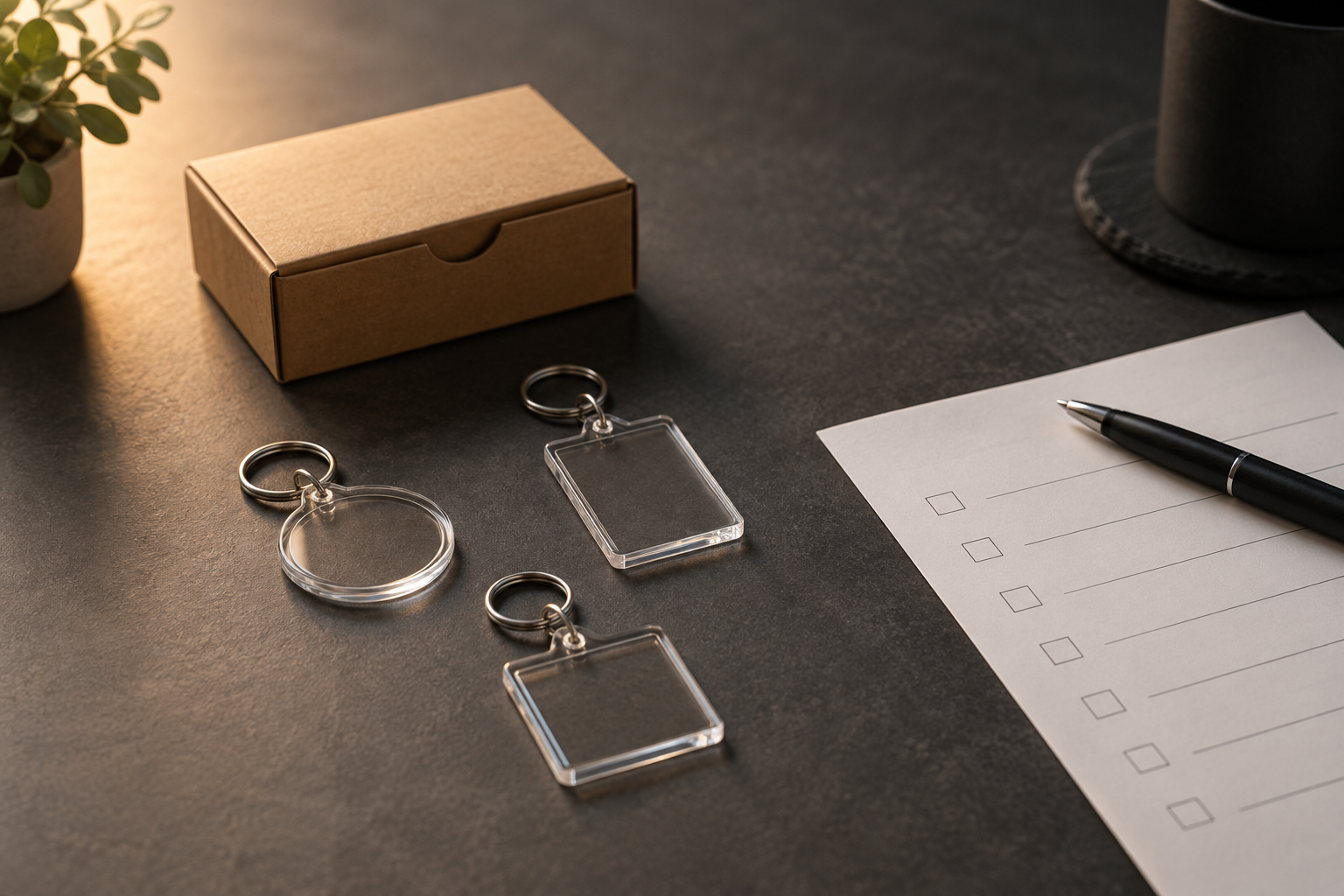
Acrylic stands, acrylic keychains and acrylic blocks are goods that are often made in China and imported for sale in Japan. When you import them, the obvious question is what rate of customs duty applies.
This guide uses Japan Customs' tariff schedule as of 31 October 2026 and its Customs Answer FAQs to set out the rates that matter for acrylic goods. Customs makes the final decision on classification, so we stick to what can be said with certainty and how to check the rest.
Acrylic goods are in Chapter 39, plastics
Acrylic is a plastic called poly(methyl methacrylate), or PMMA. In the tariff schedule it belongs to Chapter 39, plastics and articles thereof, and finished goods are mainly handled under heading 39.26, other articles of plastics.
Within heading 39.26 there are subheadings such as statuettes and other ornamental articles (3926.40) and other (3926.90). A display stand or figure-like item may fall under 3926.40 while other items fall under 3926.90, so the number can change with the item's form and use.
Rates for 3926.40 and 3926.90 (as of 31 Oct 2026)
| Code and description | General | WTO | RCEP (China) |
|---|---|---|---|
| 3926.40 Statuettes and other ornamental articles | 5.8% | 4.8% | 3% |
| 3926.90 Other (statistical code 029, other) | 5.8% | 3.9% | 1.8% |
According to Japan Customs' explanation of tariff rate types, rates are in principle applied in the order preferential, conventional (WTO), temporary and then general, and the WTO rate applies when it is lower than the temporary or general rate. China is a WTO member, so without using an EPA the reference rate is the WTO rate (4.8% for 3926.40).
RCEP (the Regional Comprehensive Economic Partnership) is an economic partnership agreement with 14 participating countries, including China. The rate in the RCEP (China) column can only be used when the agreement's rules of origin and other conditions are met; it does not apply automatically just because the goods were shipped from China.
Up to 200,000 yen: the 3% simplified rate
For ordinary import consignments and international mail with a total taxable value of 200,000 yen or less, broad "simplified rates" can be used. In the table in Customs Answer 1001, Chapter 39 (plastics and articles thereof) is in the 3% band. The same 3% band also includes Chapter 83 (miscellaneous articles of base metal) and Chapter 95 (toys, games and sports requisites).
However, simplified rates cannot be used for travellers' accompanied or unaccompanied baggage, and do not apply to goods that are duty-free or exempt or to items specified by cabinet order. If the importer asks for the general rates to be applied to all the goods, the general rates apply. Simplified rates also do not include consumption tax and local consumption tax, which are charged separately.
Up to 10,000 yen: generally exempt
According to Customs Answer 1006, goods with a total taxable value of 10,000 yen or less are exempt from customs duty and consumption tax. For postal items, the total of the goods in one package is used, but items sent separately at around the same time from the same sender to the same recipient are added together.
Some items, such as leather bags and gloves and knitted clothing, are not exempt even at 10,000 yen or less. For goods imported for personal use, the taxable value is calculated as 0.6 times the overseas retail price; see our guide to the 10,000 yen exemption and the 0.6 rule.
What to check before buying stock
- The item's form and use: a display ornament, or a practical item such as a keychain or phone stand (classification may differ)
- The taxable value of each import: 10,000 yen or less, 200,000 yen or less, or more
- Whether to use the RCEP rate: whether the rules of origin can be met and the supplier can provide the information needed
- Which edition of the rates: the tariff schedule is revised, so check the edition in force when you import
- If unsure: ask a customs counsellor at your nearest customs office (contacts are in Customs Answer 9301)
Some items, such as the Blue Archive SD phone grip stands we sell, are made of acrylic but are both decorative and practical. Because the rate depends on which code applies, it is important to check rather than decide the classification yourself.
The rates in this guide are based on the tariff schedule as of 31 October 2026 and the Customs Answer pages we checked on 22 November 2026. The tax actually payable is determined by what is declared to customs and how the goods are classified.
Sources and further reading
- Japan Customs: Tariff schedule as of 31 Oct 2026, Chapter 39 Plastics and articles thereof (Japanese)(Checked: )
- Japan Customs: Types of tariff rates (Customs Answer 1105, Japanese)(Checked: )
- Japan Customs: Simplified rates for consignments up to 200,000 yen (Customs Answer 1001, Japanese)(Checked: )
- Japan Customs: Exemption for goods with a total taxable value of 10,000 yen or less (Customs Answer 1006, Japanese)(Checked: )