/ Trade / English
What Does 执行标准 on a Chinese Product Label Mean? GB, GB/T, QB/T, T/ and Q/ Codes Explained, and What They Do and Don't Tell Buyers and Sellers in Japan
Labels on goods made in China often show lines such as "执行标准: GB 28480-2012", "T/CPQS C010-2024" or "Q/LEGS 003-2025". Using real label photos, this guide explains the national, industry, group and enterprise standards defined by China's Standardization Law, how to read the code prefixes, the official sites where you can look them up, and why these numbers cannot tell you about Japanese legal compliance or authenticity.
Written by Koetsu Co., Ltd.

Labels on acrylic stands, figures, can badges and tableware made in China often include a line called 执行标准, literally "standard implemented". It shows which standard the product was made to. On the Chinese goods we handle, this line carries numbers starting with GB, GB/T, T/, Q/ and so on.
Based on the text of China's Standardization Law, this guide sorts out the difference between these prefixes, how to read the numbers and the official sites where you can look them up. It then separates what the numbers can and cannot tell you when buying or selling Chinese products in Japan. It is not a legal interpretation or an assessment of whether any particular product complies.
The five types defined by the Standardization Law
Article 2 of the Standardization Law of the People's Republic of China, revised in 2017, says that standards consist of national, industry, local, group and enterprise standards. National standards are divided into mandatory and recommended standards, while industry and local standards are recommended standards. Mandatory standards must be followed, and the state encourages the adoption of recommended standards.
Article 21 adds that the technical requirements of recommended national, industry and local standards, and of group and enterprise standards, must not be lower than the relevant requirements of mandatory national standards. Article 25 states that products that do not meet mandatory standards must not be produced, sold or imported.
On the 执行标准 line of a label, you will mostly see national, industry, group and enterprise standards. Local standards use numbers starting with DB, but we have not yet seen one on the labels of the goods we handle. A single product may also list several standards together.
How to read the prefixes
| Example prefix | Type | Notes |
|---|---|---|
| GB 28480-2012 | Mandatory national standard | GB with no /T; must be followed |
| GB/T xxxxx-year | Recommended national standard | T stands for recommended (tuijian) |
| QB/T 5035-2017 | Recommended industry standard | QB is the code for light industry standards |
| T/CPQS C010-2024 | Group standard | T/ followed by the association's code, a number and the year |
| Q/LEGS 003-2025 | Enterprise standard | Q/ followed by the company's code, a number and the year |
The last four digits usually show the year the standard was issued. GB 28480-2012, for example, is a 2012 standard that SGS describes as a mandatory national standard setting limits on harmful elements in adornments such as jewellery. Older standards can be replaced by revised versions, so the official sites are the reliable place to check whether one is still current.
Examples on real labels
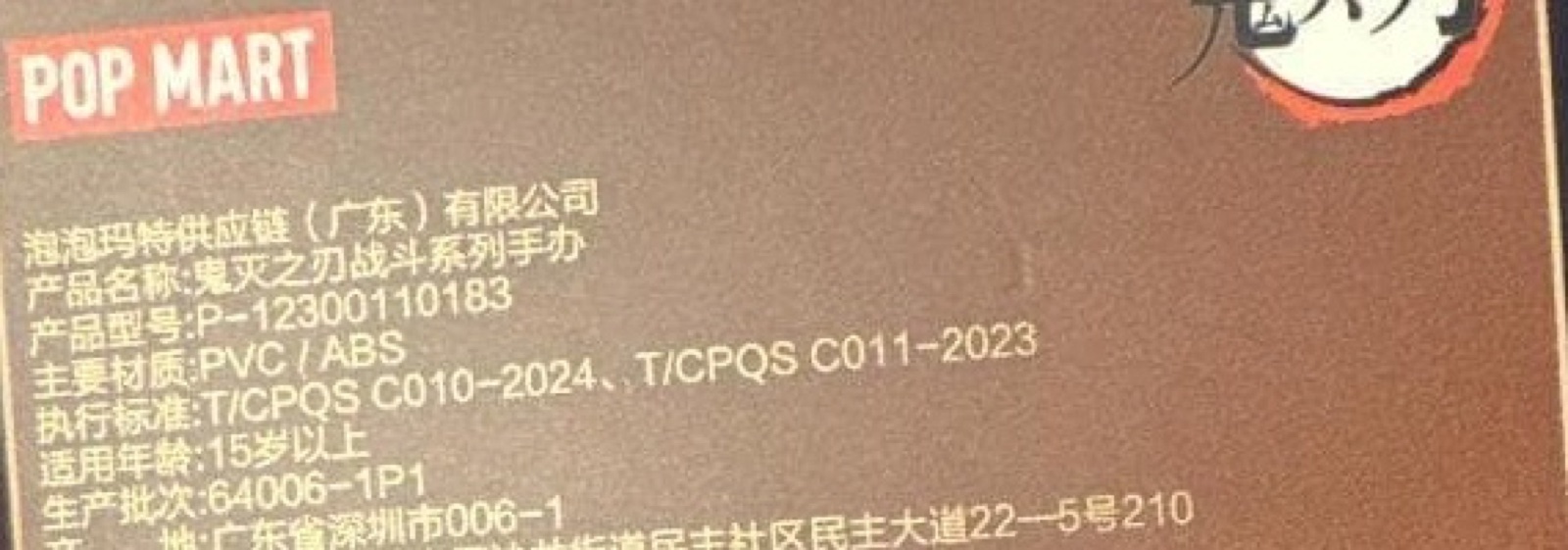
The photo above shows the box of a POP MART Demon Slayer Battle Series figure that we list on Mercari. Its 执行标准 line names two group standards, T/CPQS C010-2024 and T/CPQS C011-2023. The Wuthering Waves Yangyang acrylic stand covered on the same day lists the enterprise standard Q/LEGS 003-2025, while the label of another listing, a Madoka Magica 15th anniversary rotating acrylic stand, lists GB 28480-2012. Even among acrylic goods, the type of standard on the label varies from item to item.
Where can you look the numbers up?
- National (GB, GB/T) and industry standards: the national public service platform for standards information run by SAMR
- Enterprise standards (Q/): the public service platform for enterprise standards. Under Article 27 of the Standardization Law, companies must disclose the number and name of the standards they follow
- Group standards (T/): the national group standards information platform. Each association sets its own numbering rules
All of these sites are in Chinese, and the full text of a standard is not always free to read. The content of an enterprise standard, such as which tests it involves and what it requires, is only known to the extent the company has published it. It is safest to assume the number tells you only that the maker states it followed that standard.
What it does and doesn't tell you in Japan
| What it tells you | What it doesn't | |
|---|---|---|
| Standards | Which Chinese standard the maker says it followed | Whether it meets Japanese law (Food Sanitation Act, PSC mark, Electrical Appliances and Materials Safety Act and so on) |
| Product | Clues to the product type and material | Whether it is genuine or officially licensed |
| Year | The year the standard was issued | When the item was made (often shown on a separate line) |
For example, if you sell toys bought in China in Japan, an import notification under the Food Sanitation Act or the PSC mark rules for children's products may apply depending on the target age. A Chinese standard number on the label does not replace these procedures. See our guide before selling imported toys in Japan for details.
In our own listings, we keep descriptions to what the label actually says and do not present standard numbers as a safety guarantee or proof of authenticity. If anything on a label is unclear, feel free to ask in the comments on the listing page or contact us.
Sources and further reading
- Standardization Law of the People's Republic of China (2017 revision, Articles 2, 21, 25 and 27; Chinese)(Checked: )
- National public service platform for standards information, SAMR (Chinese)(Checked: )
- Public service platform for enterprise standards information (Chinese)(Checked: )
- National group standards information platform (Chinese)(Checked: )
- SGS: China Mandatory Standards GB 28480 for Jewelry (2013)(Checked: )