/ Trade / English
Bringing Souvenirs and Merch Back to Japan: How the 200,000 Yen Duty-Free Allowance Works, the 10,000 Yen Per-Item Rule, and Declaring Items Sent Separately
If you buy a lot of character goods and souvenirs on a trip abroad, how are they taxed when you enter Japan? Based on Japan Customs information, this guide explains how the 200,000 yen allowance is counted, the rule that items totaling 10,000 yen or less per category are generally duty-free, the simplified tax rate above the allowance, goods for resale, and how to declare items you ship separately.
Written by Koetsu Co., Ltd.
On a trip abroad, it is easy to buy more character goods and souvenirs than planned, especially items you cannot get in Japan. When you return, you may wonder whether they are taxed and how much you can bring in duty-free. Based on Japan Customs information, this guide explains how it works for souvenirs and goods for personal use.
One point up front. The allowances here apply to goods recognized as being for personal use. Items bought to resell or to sell in a shop are not treated the same way. This article summarizes public information as of November 6, 2026, and does not guarantee that any particular item will be duty-free. Japan Customs makes the final decision.
The basic allowance
According to Japan Customs, the allowance covers personal-use goods you carry with you or send separately, and it is set per person entering Japan. If you have both, they are added together. Alcohol, tobacco and perfume have their own limits, and most goods and souvenirs fall under other items, with an allowance of 200,000 yen in total overseas market value.
| Category | Allowance per person | Notes |
|---|---|---|
| Alcohol | 3 bottles (about 760 ml each) | Not duty-free for people under 20 |
| Perfume | 2 ounces (about 56 ml) | Eau de cologne and eau de toilette are not included |
| Other items | 200,000 yen total overseas market value | Goods, souvenirs, clothing and so on |
| Items totaling 10,000 yen or less per category | Generally duty-free | Not counted toward the 200,000 yen |
Overseas market value means the normal retail price abroad, that is, what you paid, converted to yen at the official published rate. For children under 6, only items clearly for the child's own use, such as toys, are duty-free. Tobacco limits vary by type, so check the Japan Customs page.
The 10,000 yen rule and counting to 200,000 yen
Japan Customs says items whose total overseas market value per category is 10,000 yen or less are generally duty-free. Its examples are nine chocolates at 1,000 yen each, or two ties at 5,000 yen each. Note that the rule looks at the total for the same category, not the price of one piece. If you buy many acrylic stands of the same type, for example, the total can pass 10,000 yen even if each one is cheap.
If other items total more than 200,000 yen, the items that fit within 200,000 yen are duty-free and the rest are taxed. Japan Customs says it chooses the duty-free items in the traveler's favor. However, a single item worth more than 200,000 yen is taxed on its full value. In the customs example, a 250,000 yen bag is taxed on the full 250,000 yen.
Tax when you go over
According to Customs Answer 7106, goods carried or sent separately above the allowance are taxed at a simplified rate that combines customs duty and consumption taxes. For other items (excluding duty-free goods), which includes most merch and souvenirs, the rate is 15%. However, the simplified rate does not apply to things such as a single item or set with a taxable value over 100,000 yen, which are charged regular duty and consumption tax. Goods with no customs duty, such as wristwatches and golf clubs, are charged only consumption tax.
Goods for resale or large quantities
Customs Answer 7104 says that simplified clearance as travelers' effects applies to souvenirs generally up to three pieces per item, or a taxable value of around 300,000 yen or less if there are more than three, and that this range includes items sent separately. Beyond that, goods go through regular clearance like commercial cargo. JETRO also explains that goods imported for sale rather than personal use need an import declaration even when you carry them in.
If you buy toys or tableware to sell in Japan, other rules such as the Food Sanitation Act also apply, in addition to tax. See our guide to selling imported toys in Japan. Ordering from overseas online follows different rules from bringing things back from a trip, so see our guide to import duty on online orders.
If you ship items home, declare them as unaccompanied baggage
If your purchases do not fit in your suitcase, you might send them home by post or courier. Customs Answer 7103 calls these unaccompanied baggage and limits them, in principle, to items that can be cleared within six months after you enter Japan. When sending them, clearly mark the package, the customs declaration and the waybill as Unaccompanied Baggage (別送品), and address it to yourself. If a shop ships it for you, the guidance says to tell the staff to add this marking.
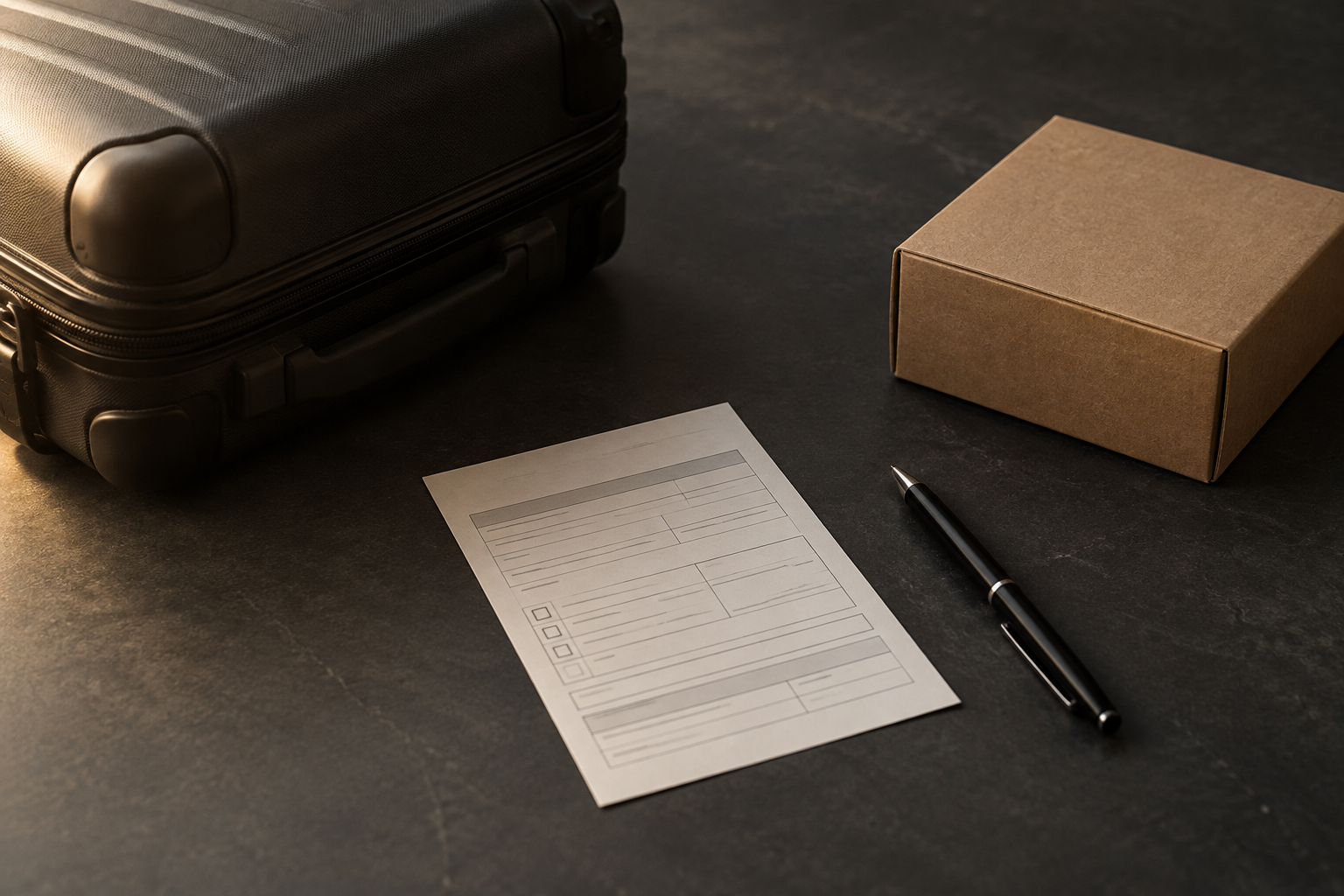
When you enter Japan, submit two copies of the Customs Declaration for personal effects and unaccompanied articles, and customs stamps and returns one copy. You need that copy to clear the unaccompanied baggage, and it cannot be reissued if lost. You cannot declare unaccompanied baggage after you have entered, and if you did not declare it or lost the stamped copy, the goods need the same import procedures as regular commercial cargo. Japan Customs asks everyone entering Japan to submit a declaration and recommends filing it electronically through Visit Japan Web.
- Keep your receipts together, since they show the overseas price
- Add up the total for each type of item, to see whether it is 10,000 yen or less
- Separate what is for your own use from items requested by others or for resale
- If you ship items home, mark them as unaccompanied baggage and submit two copies of the declaration on arrival
- When in doubt, ask a customs counselor
Summary
Goods and souvenirs bought abroad for personal use are duty-free up to 200,000 yen in total as other items, and items totaling 10,000 yen or less per category are generally left out of that count. Anything above is charged at the simplified 15% rate or similar, and goods for resale or in large quantities are handled differently. If you send items home separately, remember to declare them when you enter Japan. We do not handle customs procedures on anyone's behalf. For current information and individual cases, check Japan Customs or ask a customs counselor.
Sources and further reading
- Japan Customs: Duty-free allowances for travelers (Japanese)(Checked: )
- Japan Customs Answer 7106: Simplified tax rates for personal effects (Japanese)(Checked: )
- Japan Customs Answer 7104: Goods cleared as travelers' effects (Japanese)(Checked: )
- Japan Customs Answer 7103: Declaring unaccompanied baggage (Japanese)(Checked: )
- Japan Customs: Submitting the declaration for personal effects and unaccompanied articles (Japanese)(Checked: )
- JETRO: Customs procedures for small purchases carried into Japan (Japanese)(Checked: )