/ Trade / English
Does a Barcode Starting with 69 Mean Made in China, and 45 or 49 Made in Japan? GS1 Prefixes vs Country of Origin, and What to Check Instead
You may have heard that the first digits of a barcode tell you where a product was made. According to GS1, the prefix shows which national GS1 organisation issued the code, not the country of origin. This guide explains the 13-digit structure, how the check digit works, a real label example, and what to look at instead when origin matters.
Written by Koetsu Co., Ltd.
You may have seen claims on social media that products whose barcodes start with 69 are made in China, while 45 or 49 means made in Japan. When buying goods from abroad, some people try to judge where something was made from its barcode. The short answer: the first digits of a barcode do not tell you the country of origin.
Drawing on the explanations of GS1, the organisation that runs the international product barcode system, this guide covers what the prefix means, how the 13 digits are built, and what you should actually look at when you want to know where something was made. We use the label on one of our own listings as an example.
The prefix shows which GS1 office issued the code
What Japan calls a JAN code is known internationally as a GTIN (Global Trade Item Number), a standard identifier that shows which company a product belongs to and which product it is. To put codes on products, a company first gets a GS1 Company Prefix. GS1 Japan issues prefixes beginning with 45 or 49 to Japanese companies.
The GS1 website lists which prefixes are assigned to each national GS1 organisation: for example, 450–459 and 490–499 belong to GS1 Japan, and 680–681 and 690–699 to GS1 China. It then states plainly that because GS1 member companies can manufacture products anywhere in the world, GS1 prefixes do not identify a product's country of origin.
| Prefix | Assigned to (per GS1) | What it does and does not tell you |
|---|---|---|
| 45, 49 | GS1 Japan | The company got its prefix from GS1 Japan; where it was made is unknown |
| 690–699, 680–681 | GS1 China | The company got its prefix from GS1 China; where it was made is unknown |
| 040–049 | Restricted circulation numbers for use within a company | In-house codes; not standard product codes |
It is quite common, for example, for a Japanese company to put its own 49 code on products made in a factory abroad. Equally, a product carrying a Chinese company's code could have been made in another country. All the prefix tells you is which GS1 office the company that owns the code is registered with. GS1 also notes that 12-digit codes (UPCs, used in the US and elsewhere) are read with an implied leading zero, so a 12-digit code starting 614 has the prefix 061.
Inside the 13 digits, and the check digit
According to GS1 Japan, the standard 13-digit type is made up of the GS1 Company Prefix (9, 10 or 7 digits), an item reference (3, 2 or 5 digits) and a single check digit. The last digit is calculated from the first 12 and is used to catch reading errors. It is not a way to tell whether a product is genuine.
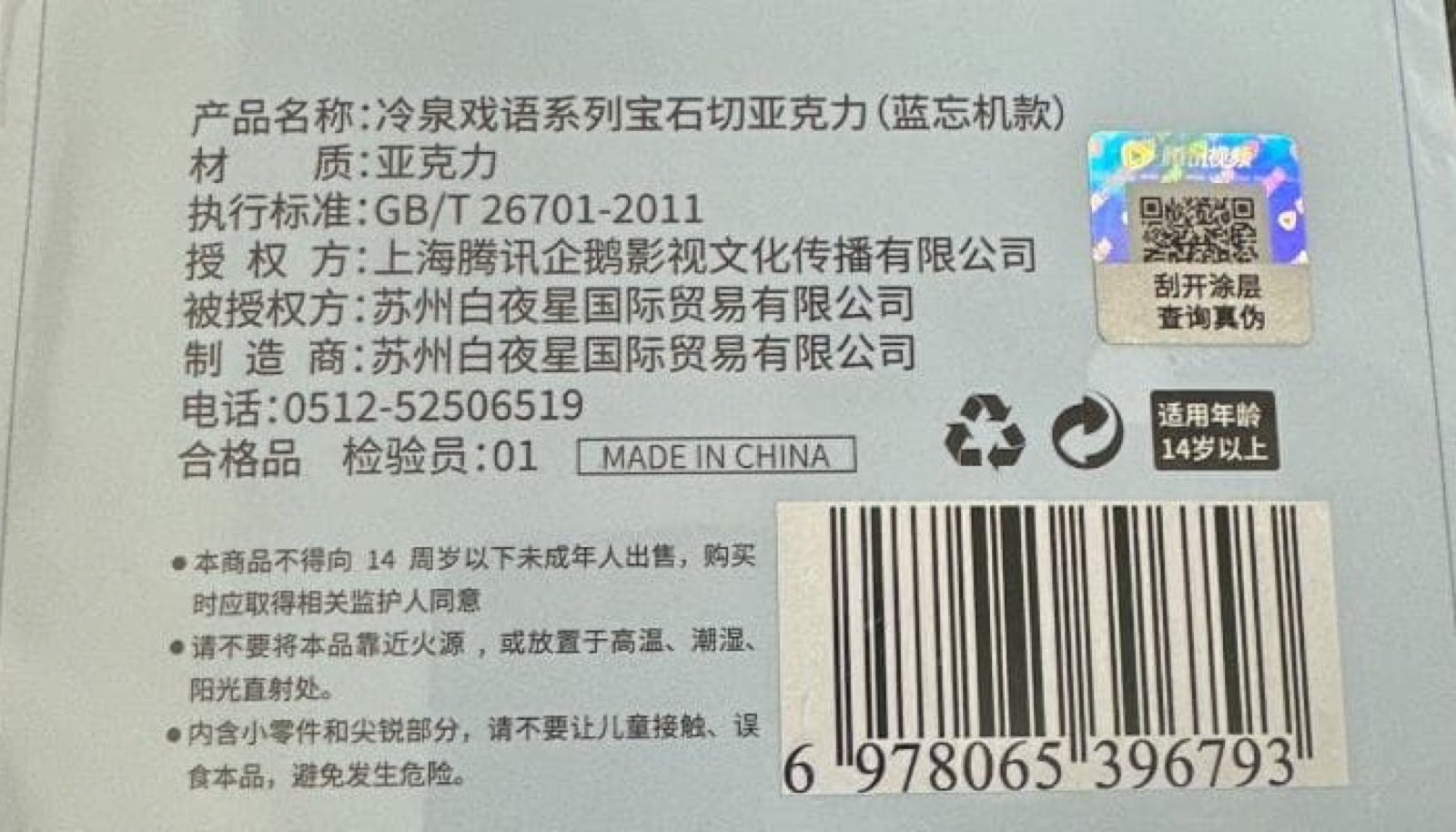
The photo above is the back label of a Chinese anime collectible we list on Mercari. The barcode is 6978065396793. Because it starts with 69, we know the code belongs to a company registered with GS1 China. To check the last digit: add the digits in odd positions from the left (6, 7, 0, 5, 9, 7 = 34) to three times the digits in even positions (9, 8, 6, 3, 6, 9 = 41, × 3 = 123) to get 157. Subtract the last digit of that, 7, from 10 and you get 3, which matches the final digit.
So how do we know this item was made in China? Not from the barcode, but because the same label says MADE IN CHINA and lists a Suzhou company as the 制造商 (manufacturer). When you want to know where something was made, read labels like these rather than the barcode.
Where to check country of origin
Under the operating standards of Japan's Consumer Affairs Agency, the country of origin is the country where the act that substantially changed the product's content took place. Attaching labels, putting items into containers or packaging, and simply combining items do not count as substantial changes. In other words, the country where something was last packed, or where the selling company is based, is not automatically the country of origin.
- Origin, MADE IN … or 制造商 (manufacturer) markings on the box, backing card or tag
- The listing description (whether the seller states the country of origin)
- If it is not stated, ask the seller for a photo of the label
- Do not use the barcode prefix to judge origin or authenticity
When shopping on a flea-market app, check whether the listing photos show the label, and if not, ask in the comments before buying. We explain the difference between where an item was bought and its country of origin in more detail in this guide.
A barcode is a number that lets checkouts and inventory systems identify a product correctly. Its prefix only shows which GS1 office issued the code; it cannot tell you where the item was made or whether it is genuine. The more origin matters to you, the more important it is to read the label text itself.