/ Trade / English
What Is Japan's Household Goods Quality Labeling Act? What to Check Before Selling Imported Umbrellas, Bags, Tableware and Other Goods in Japan: Covered Items, Who Labels, Japanese-Language Labels and Online Sales
Japan's Household Goods Quality Labeling Act requires quality labels on designated household goods. Based on the Consumer Affairs Agency's explanations and FAQ, this guide covers the four product groups and example items, who does the labelling, the need for Japanese labels on imported goods, how online product pages are treated, and why personal imports and giveaways are outside the law.
Written by Koetsu Co., Ltd.
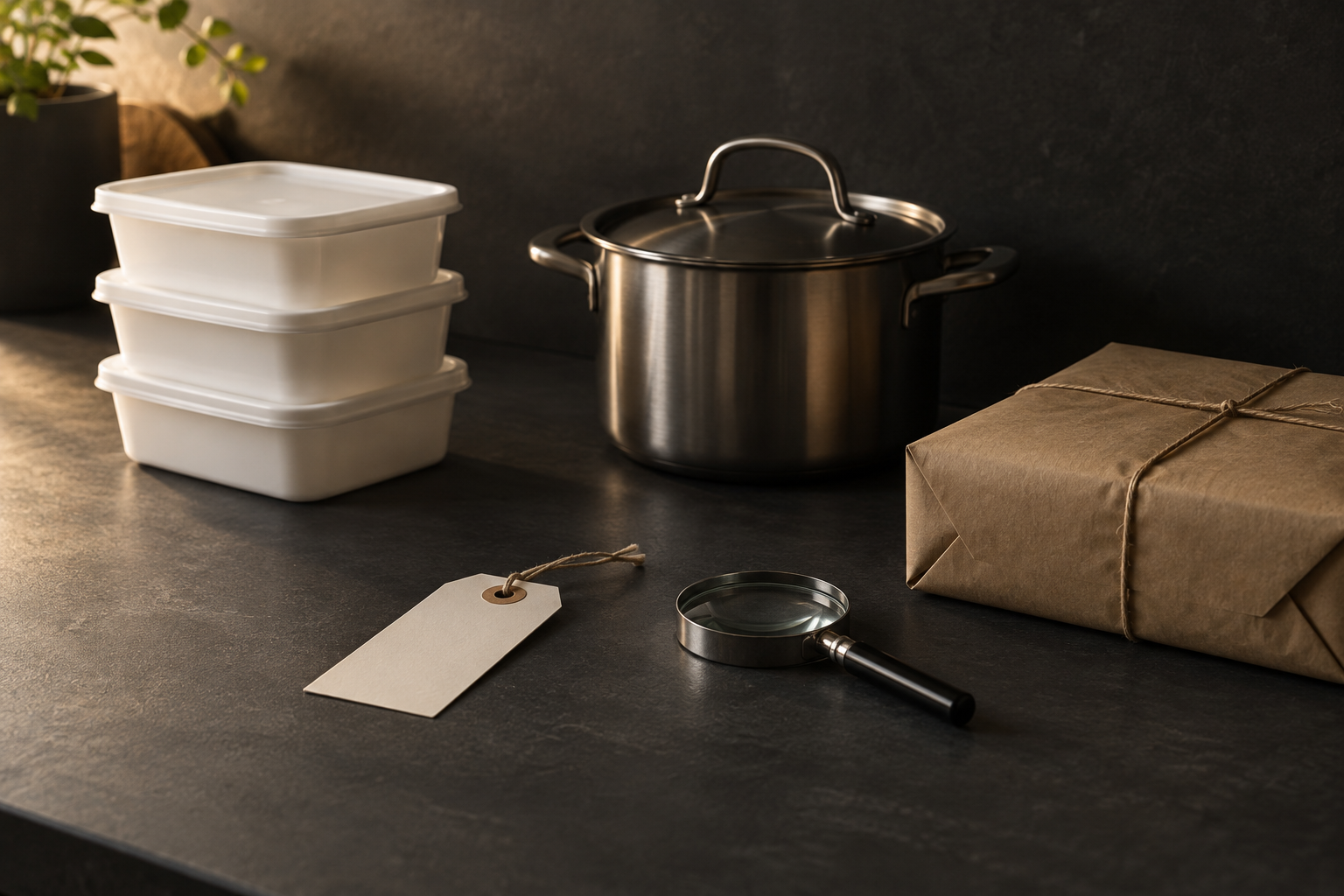
If you buy household goods from overseas factories or wholesalers and plan to sell them through a Japanese online shop or flea-market app, one of the laws to check is the Household Goods Quality Labeling Act. Some goods, such as umbrellas, bags, tableware and pots, need specified quality labels when they are sold in Japan.
Based on the Consumer Affairs Agency's explanation pages and FAQ, this guide sets out the purpose of the law, which items are covered, who labels them, and how imported goods and online sales are treated. If you need a ruling on whether a particular product is covered, check the Agency's rules for each item or contact the Agency.
What the law does
According to the Consumer Affairs Agency, the Household Goods Quality Labeling Act was enacted in 1962 to make quality labelling on household goods accurate and protect the interests of ordinary consumers. It designates household goods whose quality is hard to judge when buying and especially needs to be known, and sets out what must be labelled and how.
The key point is that not every household item is covered; only items designated by Cabinet Order or Cabinet Office Ordinance must be labelled. The designated items come from four groups, textile products, synthetic resin products, electrical machinery and appliances, and miscellaneous manufactured goods, and each group has its own quality labelling rules.
Examples of covered items
The table below lists examples from the Consumer Affairs Agency's list of covered items that importers are likely to deal with. It is only part of the list, and some items come with detailed conditions. For example, the FAQ on miscellaneous manufactured goods explains that bags are covered when they use cow, horse, pig, sheep or goat leather, and synthetic leather bags are not covered.
| Group | Example items |
|---|---|
| Miscellaneous manufactured goods | Umbrellas, bags (cow, horse, pig, sheep or goat leather), desks and tables, chairs, pots, vacuum flasks, shoes, toothbrushes, sunglasses, water purifiers |
| Synthetic resin products | Tableware and kitchenware (containers, plates, chopping boards and so on), trays, water bottles, baskets, buckets, polyethylene or polypropylene film bags |
| Textile products | Gloves, socks, blankets and more |
| Electrical machinery and appliances | Electric kettles, microwave ovens, refrigerators and more |
On the other hand, toys, character goods and printed items such as posters do not appear on the list of covered items (for paper, only tissue and toilet paper and shoji paper are listed). However, the Agency does not explicitly say that items missing from the list are excluded, so check the rules for each item when in doubt. Toys are subject to other rules such as the Food Sanitation Act and the PSC mark; see our guide to selling imported toys in Japan.
Who labels and what
The labelling is done by the manufacturer, the seller, or a labelling contractor commissioned by either of them. The FAQ explains that importers, wholesalers and retailers can also be the labeller as sellers, provided they can properly handle consumer enquiries and government inspections, and that the parties must decide among themselves who the labeller will be.
What must be labelled is set by the rules for each item, such as composition, performance, intended use and handling precautions. The label also gives the labeller's name and either an address or a phone number. According to the FAQ, the address must be written in Japanese starting with the prefecture, and the phone number must include the area code. An email address, URL or QR code cannot replace the address or phone number.
Imported goods and online sales
The Consumer Affairs Agency FAQ says that even imported goods, when sold to ordinary consumers in Japan, must carry the required label items properly in Japanese. The label must be in place at the point of sale to consumers, and the FAQ explains that the labeller details should be those of a business based in Japan.
The FAQ also explains that an online shop shipping directly from overseas to consumers still needs Japanese labels when selling to consumers in Japan, regardless of the shipping route. Online product pages, on the other hand, are treated as a kind of advertising and are not subject to the labelling obligation, though the Agency says it is desirable to show the same details as the label on the product.
Personal imports, where an individual buys directly from an overseas seller for their own use, are outside this law. Giveaways and novelties are also outside it. How the law treats individuals selling their own unwanted items is not covered on the Consumer Affairs Agency pages we checked.
What happens if labels are missing
If labels are missing or not done in the required way, the government can issue a directive telling the business to label, and can make the matter public if the business does not comply. There are also provisions for ordering labelling backed by penalties and for banning the sale of unlabelled goods. The Consumer Affairs Agency also publishes consumer alerts about improper labelling it learns of, including cases reported by businesses themselves.
What to check before you stock goods
- Whether the product is on the Consumer Affairs Agency's list of covered items (including any detailed conditions for that item)
- Who will attach the Japanese label and when (the supplier, your own business or a contractor)
- Whether you can provide the labeller's name and an address starting with the prefecture or a phone number with area code
- Whether the label will be on the product at the point of sale to consumers
- Whether you will show the same details on your online product page
- Whether other laws also require markings, such as the PSE mark for electrical products
If you handle electrical products, the PSE mark under the Electrical Appliances and Materials Safety Act also comes into play, separately from this law; see also our PSE mark guide. For how to tell whether goods come through official channels, see our guide to parallel imports.
This guide is a general explanation based on the Consumer Affairs Agency pages as checked on 19 November 2026, not a legal ruling on any specific product. To confirm whether a product you sell is covered and how it should be labelled, check the Agency's rules for each item or consult a professional or the Agency.
Sources and further reading
- Consumer Affairs Agency: What the Household Goods Quality Labeling Act is (Japanese)(Checked: )
- Consumer Affairs Agency: How the Household Goods Quality Labeling Act works (Japanese)(Checked: )
- Consumer Affairs Agency: List of items covered by the Act (Japanese)(Checked: )
- Consumer Affairs Agency FAQ: General questions about the Act (Japanese)(Checked: )
- Consumer Affairs Agency FAQ: Miscellaneous manufactured goods (Japanese)(Checked: )