/ Osaka Food / English
What Is Unzen Ham on a Yakitori Menu? Why This Ham Is Closer to Sausage, and What to Ask Before Ordering
What is the Unzen ham you may see on a yakitori menu? Using a photo Yakitori Senkichi published on Google, this guide looks at a Shimabara, Nagasaki product labeled as pork sausage, how Japan's standards separate ham from sausage, typical ingredients, how to eat it on a skewer, and what to ask before ordering.
Written by Koetsu Co., Ltd.
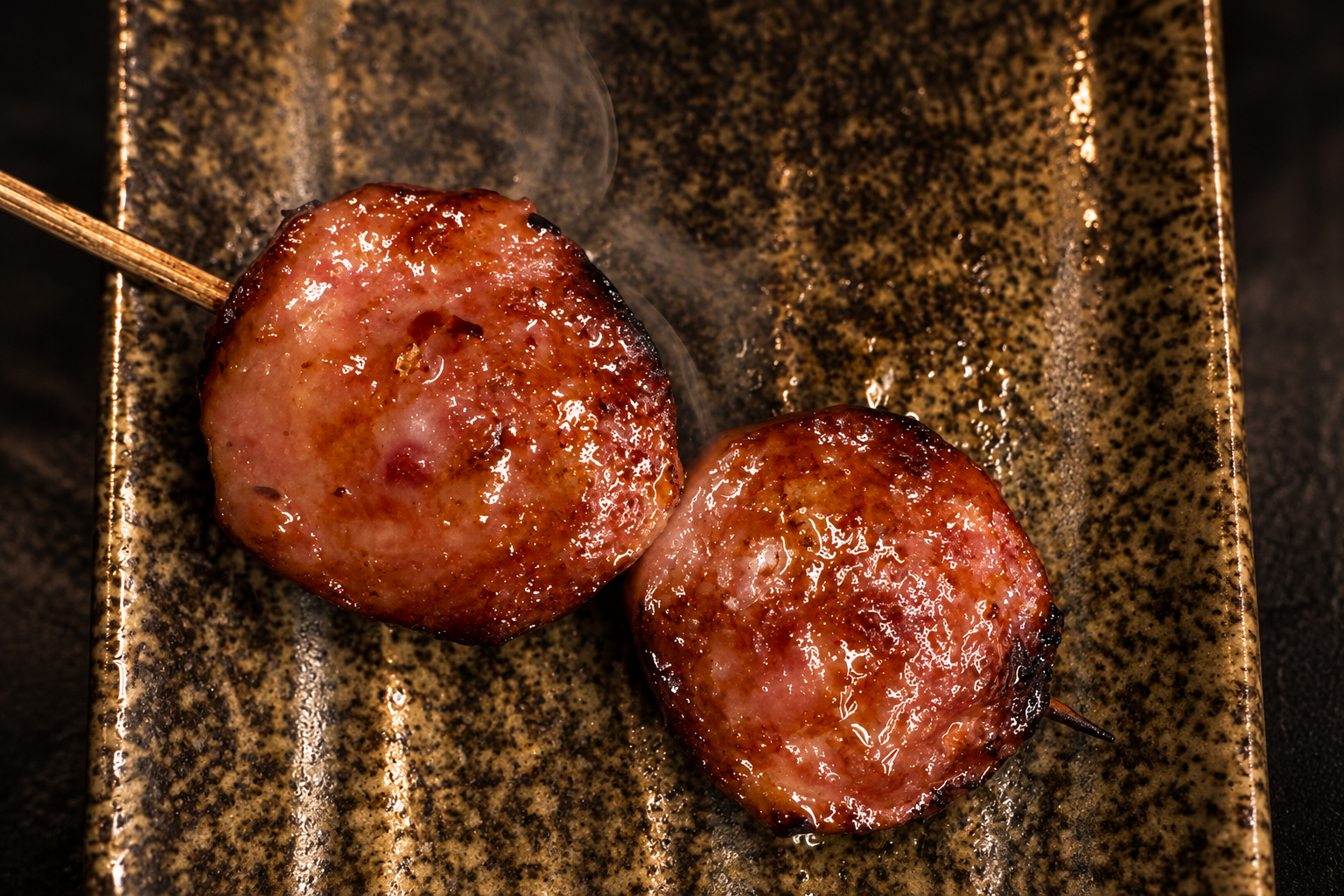
Seeing Unzen ham (雲仙ハム) on a yakitori menu, you might picture a thin slice of ham on the grill. At Yakitori Senkichi in Minamikyuhoji, the menu as of October 2026 listed Unzen ham under the day's recommendations, and an Unzen ham skewer also appeared in the set and course contents. It is not chicken, yet it sits on this yakitori menu.
This guide uses a photo the restaurant published on Google and public information on a product from Shimabara, Nagasaki to explain what Unzen ham is and how it differs from regular ham and sausage. We have not confirmed the maker or recipe of the Unzen ham served at Senkichi for this article, so we do not claim it is the same as the product described here.
The skewer in a photo
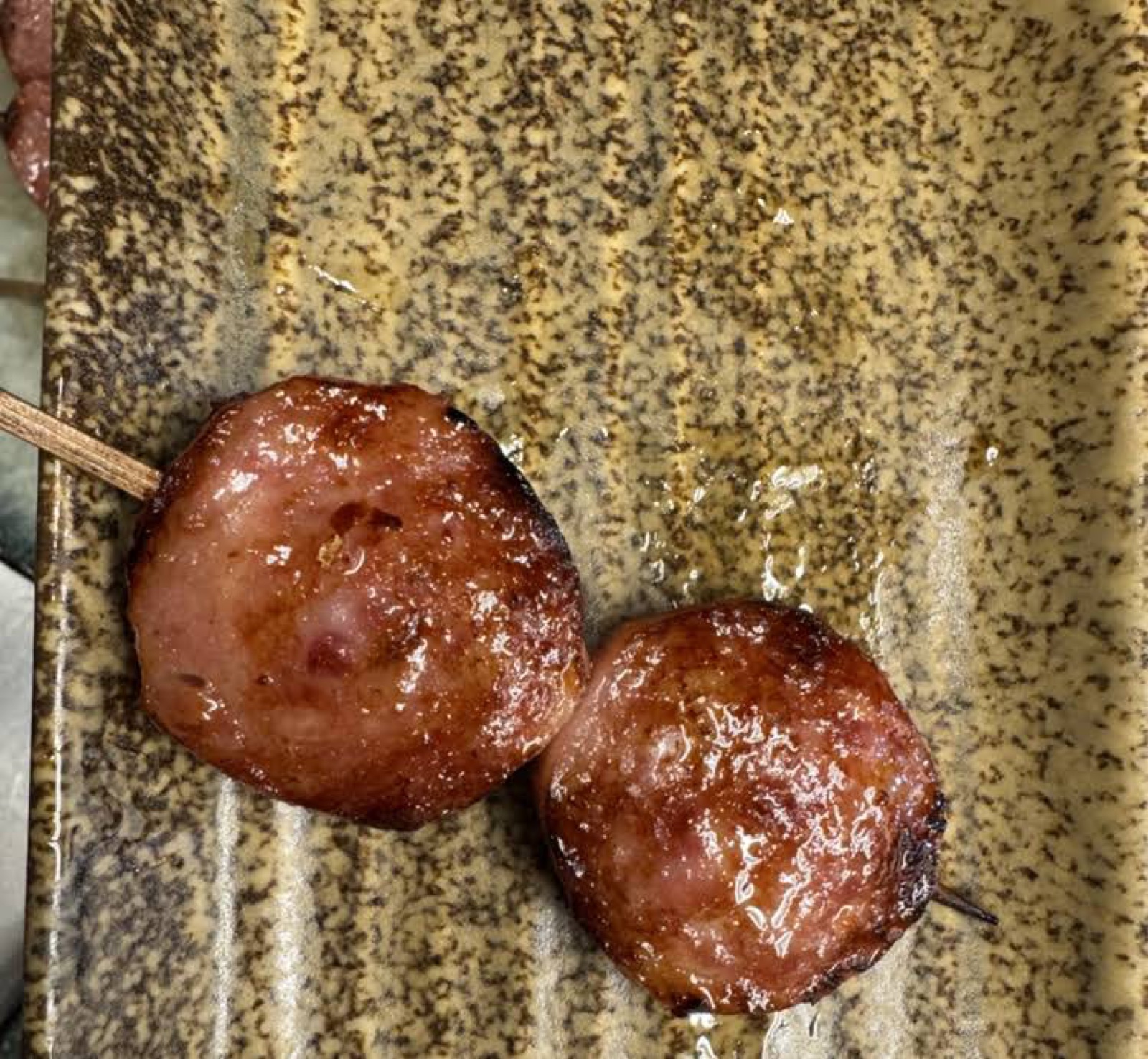
The skewer in the photo holds two round slices. Instead of a folded thin slice of ham, you see a cross-section that looks like a thick sausage cut into rounds. The surface is browned and glossy, and parts of the edge are darkened. The number of slices, the degree of browning and the seasoning reflect that particular photo, so they may not be the same every time.
So what is Unzen ham?
One example we can check publicly is a hometown tax gift from Shimabara City, Nagasaki. The supplier is Nagasaki Unzen Ham ASTY, the contents are listed as pork sausage, 800 g x 2, and each piece is about 37 cm long and 5 cm across. The page gives Shimabara as the place of manufacture and describes it as the city's traditional ham. So although the name says Unzen, this product is made in Shimabara.
A monitor report page for a mail-order product introduces Unzen ham as a Bologna sausage and a casual local food of Nagasaki. That page doubles as promotion, though, and is not a statistic on how widely people eat it. We do not claim in this article that it is a Nagasaki staple.
Now the ingredients. The Shimabara product lists pork, potato starch, onion, sugars, salt, pepper, egg powder, seasoning (amino acids and others), phosphate, color fixatives and a polysaccharide thickener, and names egg and pork as allergens. If you assumed it was only meat, the egg and starch may come as a surprise. Recipes likely differ by maker, so treat this only as one example.
Why is this ham closer to sausage?
Under Japanese standards, ham and sausage are separated by the form of the meat. According to the Consumer Affairs Agency, ham is made from a single cut of pork in one piece. The Japanese Agricultural Standard for sausage is built around ground meat, and Bologna, Frankfurter and Wiener are told apart by casing or thickness.
| Type | Key point of the standard |
|---|---|
| Ham | One piece from a single cut of pork (leg, loin, shoulder or belly) |
| Wiener sausage | Sheep casing, or under 20 mm thick |
| Frankfurter sausage | Pig casing, or at least 20 mm and under 36 mm thick |
| Bologna sausage | Beef casing, or 36 mm thick or more |
The Shimabara product is labeled pork sausage and is about 5 cm across, which is above the 36 mm line for Bologna on thickness alone. So it helps to think of it as called ham but built more like a sausage. The labeling category is set product by product, however, so this does not mean every Unzen ham falls into the same one.
Eating it from the skewer
With a whole round slice on the skewer, each bite may feel bigger than a piece of chicken. The fat on the surface is hot right after grilling, so give it a moment. If it is hard to bite, it is fine to slide it off with chopsticks and cut it. If you are unsure about skewers in general, see our guide on eating yakitori on or off the skewer.
- Let it rest briefly, as it is hot right after grilling
- If it is hard to bite, slide it off with chopsticks and cut it
- If you are sharing, ask whether it can be cut first
- The seasoning can vary by restaurant and day, so ask when ordering if it matters
Choose whatever you like to drink. It is a salty, fatty processed meat, so beer or a highball are natural options, and alternating it with lighter skewers is another way to go. If you are stuck on the first drink, see our first drink guide.
What to ask before ordering
The most important point is allergies and dietary restrictions. The example above contains egg and pork, but we have not confirmed the ingredients of the Unzen ham at Senkichi for this article. If you avoid egg or pork, or have other allergies, do not assume it is fine because it is ham. Please ask the restaurant before ordering.
It also depends on whether you order it on its own or as part of a set or course. As our course or a la carte guide notes, Unzen ham has appeared in course contents, but those can change. This article reflects what we checked on November 5, 2026. Please confirm the current menu and prices on the Yakitori Senkichi website or at the restaurant.
Sources and further reading
- Furunavi: Unzen Ham sausage, 800 g x 2 (Shimabara City, Nagasaki; Japanese)(Checked: )
- Monitor Station: Unzen ham monitor report (promotional; Japanese)(Checked: )
- MAFF: Japanese Agricultural Standard for sausage, comparison table (Japanese)(Checked: )
- Consumer Affairs Agency: labeling rule review material, definitions of ham and related products (Japanese)(Checked: )
- Yakitori Senkichi official website(Checked: )