/ Osaka Food / English
Japanese-Style Cabbage Rolls in Dashi: Why They Are Tied with Kanpyo, How to Eat Them Hot, and Where Kanpyo Comes From
Using a photo Yakitori Senkichi published on Google of cabbage rolls tied with kanpyo, this guide covers Japanese-style cabbage rolls in dashi (also a familiar oden item), why tying them with kanpyo keeps them intact, how kanpyo is made from bottle gourd and where it is produced, and how to eat them safely while the broth is hot.
Written by Koetsu Co., Ltd.
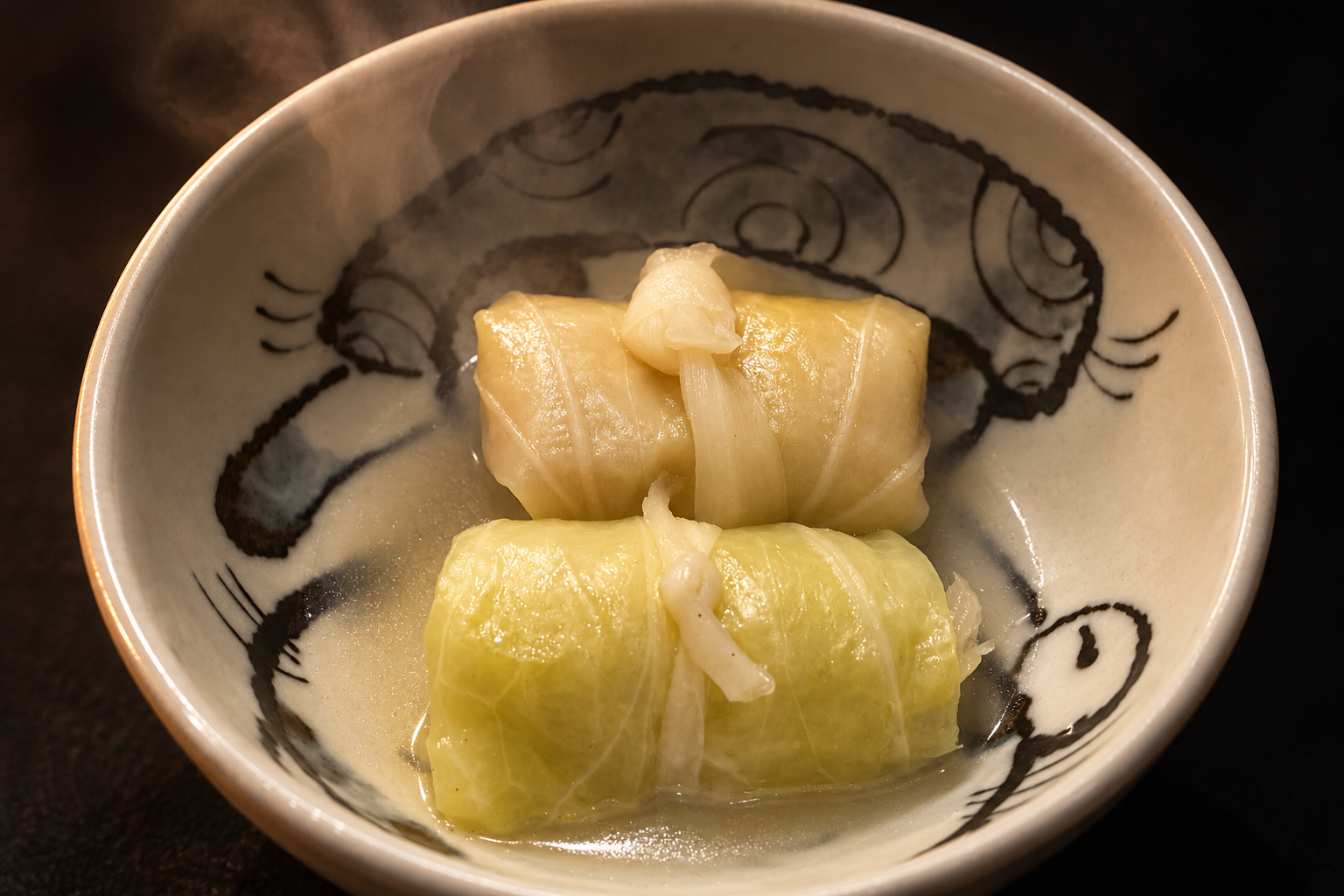
Between skewers at a yakitori restaurant or izakaya, you may feel like something warm and simmered. One option is a Japanese-style cabbage roll cooked in dashi. Using a photo Yakitori Senkichi published on Google of cabbage rolls tied with kanpyo, this guide looks at what the dish is, why it is tied with kanpyo, how kanpyo is made and where it comes from, and how to eat it while it is hot, based on material from public bodies and food writers.
What the dish in the photo looks like
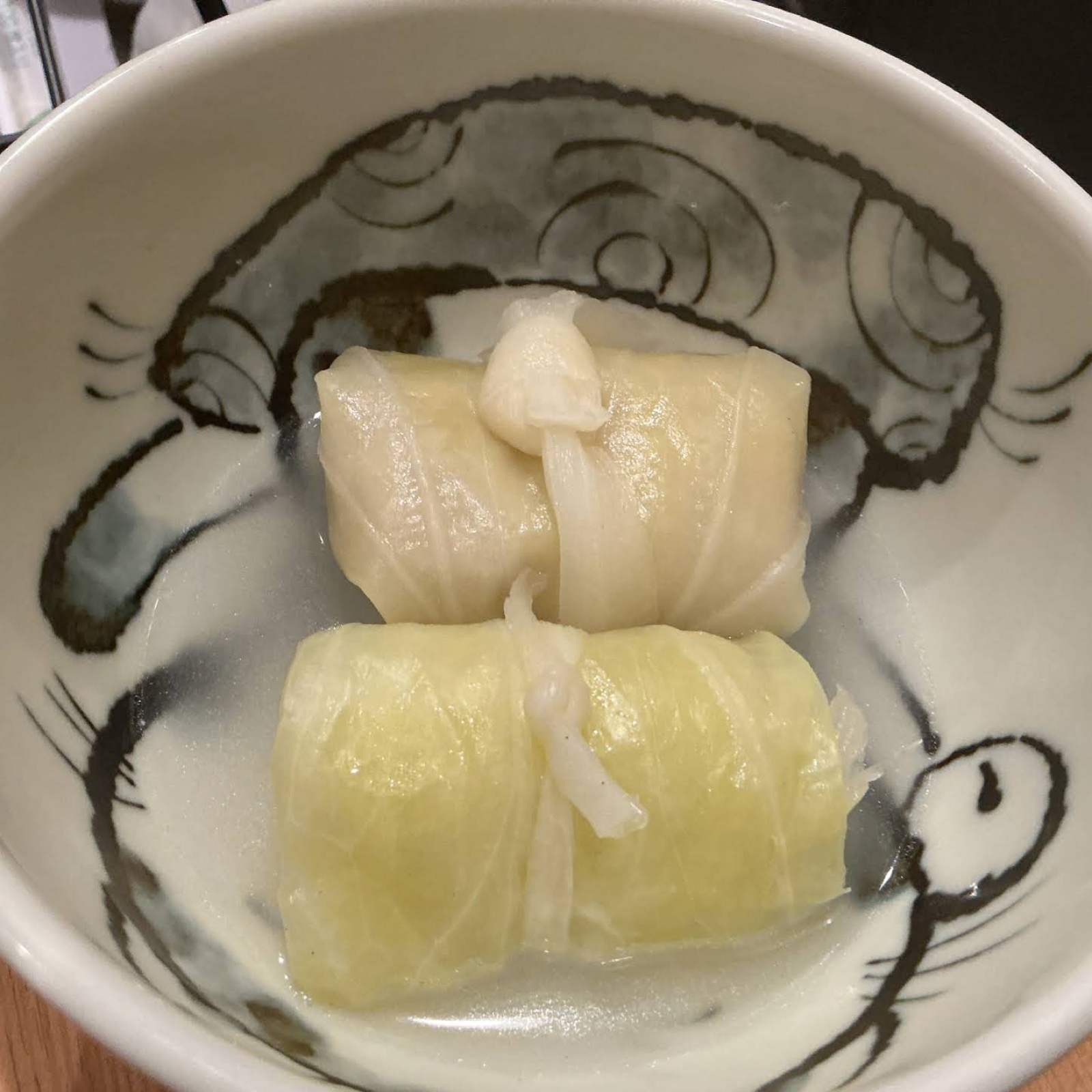
The photo shows two cabbage rolls side by side in a white bowl with an ink-brush pattern. Each is a filling wrapped in cabbage leaves and tied around the middle with a thin strip of kanpyo. The roll at the back looks whitish and the one in front is pale green, probably because different parts of the leaf were used. The clear broth in the bowl shows that this is a Japanese-style version simmered in dashi rather than in tomato or cream sauce.
Cabbage rolls as an oden item
Cabbage rolls are usually thought of as a Western-style dish, but in Japan they are also a familiar ingredient in oden, the dashi-simmered hotpot. An article on oden ingredients in the magazine site Santatsu says it is not clear how they came to be added to oden, but that they are now recognised as a standard oden item. Cabbage that has soaked up dashi becomes soft and mild.
From the photo alone, you cannot tell whether this dish is served as part of oden or as a stand-alone simmered dish, and the filling and seasoning can vary by restaurant and by day. If you want to know, just ask the staff when you order.
Why it is tied with kanpyo
The Santatsu article describes tying them with kanpyo as a distinctly Japanese method, and explains that once tied with kanpyo the rolls will not come apart, so you do not need to be so careful about how you wrap them.
Because the rolls keep their shape even after a long simmer in dashi, they look neat in the bowl and the filling is less likely to spill when you lift them with chopsticks. The kanpyo knot also softens as it absorbs the dashi, and you can eat it together with the roll.
What kanpyo is: a dried food made from bottle gourd
Kanpyo is a dried food made by peeling the fruit of the bottle gourd (yugao) into long ribbons and drying them. A Shiga Prefecture press report on Minakuchi kanpyo from Koka City describes the traditional method: bottle gourds about 30 cm across and 30 cm tall, weighing around 10 kg, are peeled into strips about 3 cm wide and 3 mm thick, hung on bamboo poles and dried in the sun for two days.
According to the same report, kanpyo making is said to have begun in Minakuchi around 1600 and later spread to Mibu in Shimotsuke Province, today's Tochigi Prefecture. Tochigi is now the main producing area: the trade paper Nihon Shokuryo Shimbun reported that Tochigi is said to account for about 98% of domestic production, with output of 260 tonnes in 2019.
Eating it while the broth is hot
A cabbage roll simmered in dashi is hot right through the leaves and the filling, and because the leaves hold broth, hot liquid can burst out as you bite. Cut it in half with your chopsticks first and let some of the steam escape before eating; that makes it much less likely you will burn your mouth.
The leaves are easier to cut with chopsticks if you go along the grain of the leaf. If the kanpyo knot is hard to cut, push your chopsticks in beside the knot, or move the roll to a small plate first and divide it there. The dashi left in the bowl is good to drink as it is.
Checklist before you order
- Is it on the menu today, and is it oden or a separate dish?
- What is in the filling (if you have allergies or dislikes)?
- Ask for small plates if you are sharing
- Cut it in half and let the steam escape before the first bite
- The kanpyo knot can be eaten too
At Yakitori Senkichi in Minamikyuhoji, Osaka, you can order side dishes alongside the charcoal-grilled skewers. Please ask the staff about the day's menu and what goes into each dish when you visit.
Sources and further reading
- Santatsu (Sanpo no Tatsujin): how to make cabbage rolls for oden, by Tokyo Oden-dane (Japanese)(Checked: )
- Shiga Prefecture press report: Minakuchi kanpyo and its 400-year tradition (August 2026, Japanese)(Checked: )
- Nihon Shokuryo Shimbun: domestic kanpyo supply shortage keeps prices high (December 2019, Japanese)(Checked: )
- Yakitori Senkichi Minamikyuhoji official site (Japanese)(Checked: )