/ Osaka Food / English
What Are Pork Belly Wraps at a Yakitori Restaurant? Why Asparagus and Shrimp with Shiso Are Rolled in Pork Belly, Why Pork Is Always Cooked Through, and What to Check Before Ordering at Yakitori Senkichi
Pork belly wraps (butabara-maki) on a yakitori menu are vegetables, shrimp or other fillings rolled in thin slices of pork belly and grilled. This guide covers what the photos of Yakitori Senkichi's extra-thick asparagus wrap and shrimp and shiso wrap show, the rule that pork may not be served raw in Japan, asparagus seasons and origins, and how to check about shrimp allergies.
Written by Koetsu Co., Ltd.
Next to the skewers of different chicken cuts, yakitori menus often list butabara-maki, or pork belly wraps: fillings such as vegetables or shrimp rolled in thin slices of pork belly and grilled. At Yakitori Senkichi in Minamikyuhoji, the in-store mobile ordering menu we checked in late October 2026 listed "extra-thick asparagus pork belly wrap" (435 yen, under side dishes) and "shrimp and shiso pork belly wrap (recommended)" (379 yen, under grilled skewers). Prices and items can change, so please check the menu in the restaurant for the latest information.
This guide explains what pork belly wraps are, what the photos do and do not tell you, why pork is always cooked through, when asparagus is in season and where it comes from, and what to check about skewers that use shrimp, based on public information and the photos the restaurant has published.
What is a pork belly wrap?
Butabara is pork belly, the cut from the underside of the pig with layers of lean meat and fat. For a wrap it is sliced thin, rolled around a filling and grilled, either on a skewer or as it is. Most dish names follow the pattern "filling + butabara-maki", so the first half of the name tells you what is inside. Yakitori Senkichi's menu also lists a plain pork belly skewer, butabara (303 yen), with no filling.
Because pork belly is fatty, the fat melts as it grills and coats the filling. It adds the savoury taste and saltiness of pork to mild vegetables such as asparagus or to fillings that cook quickly, such as shrimp. It is a rich dish, so if you prefer lighter flavours, one option is to order fewer of these and combine them with other skewers.
What the photos do and do not tell you
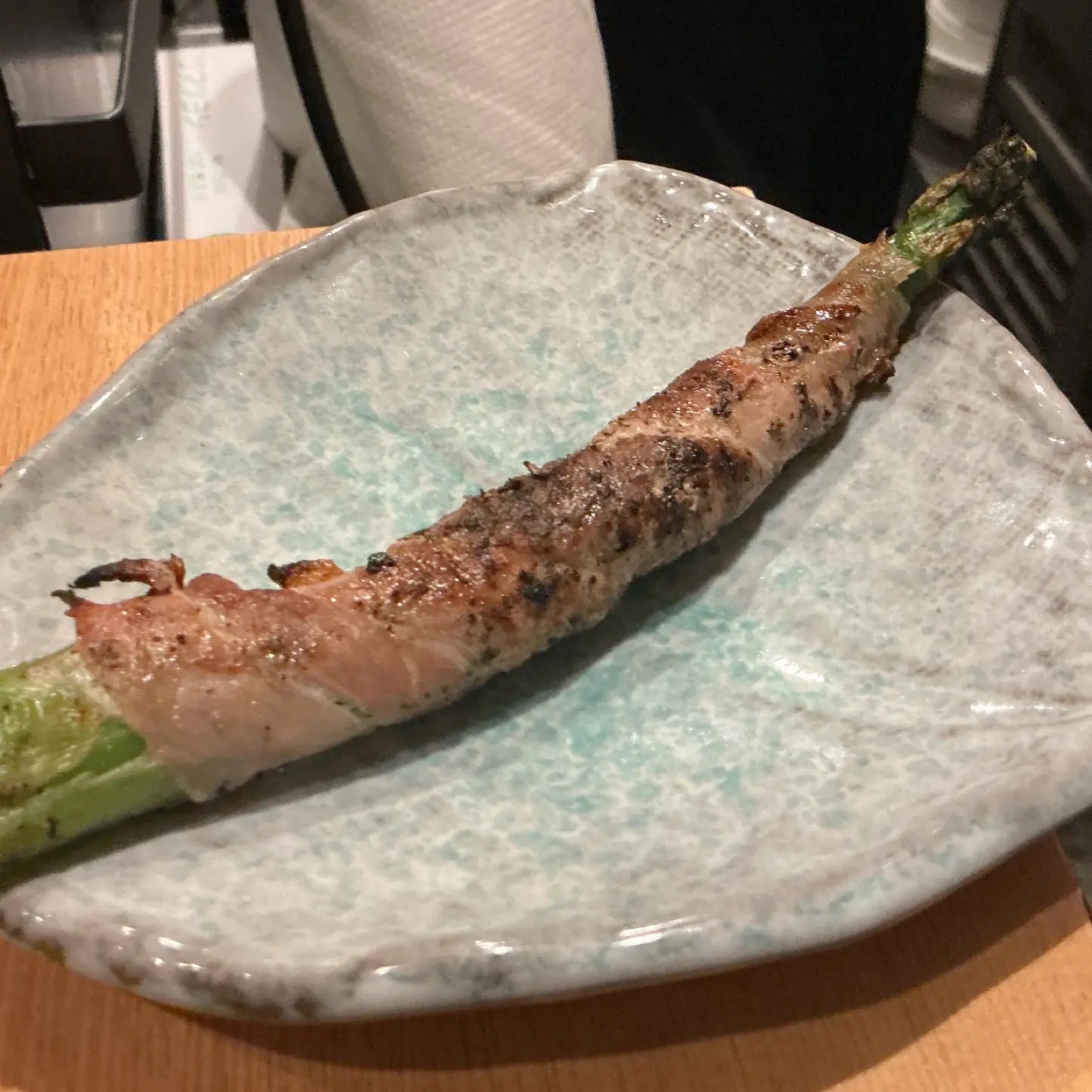
In the photo of the extra-thick asparagus wrap, one thick asparagus spear is wrapped in a spiral of thin pork belly slices. The surface is browned with dark specks, and the green of the asparagus shows at the tip and the base. No skewer is visible in the photo; the single spear is served as it is on the plate.
The dark specks look like pepper, but from the photo alone you cannot tell whether the seasoning is salt, pepper or tare sauce. We also could not confirm from public information where the asparagus comes from, what counts as extra-thick, or how many pieces come on a plate. If any of this matters to you, the surest way is to ask the staff when you order.
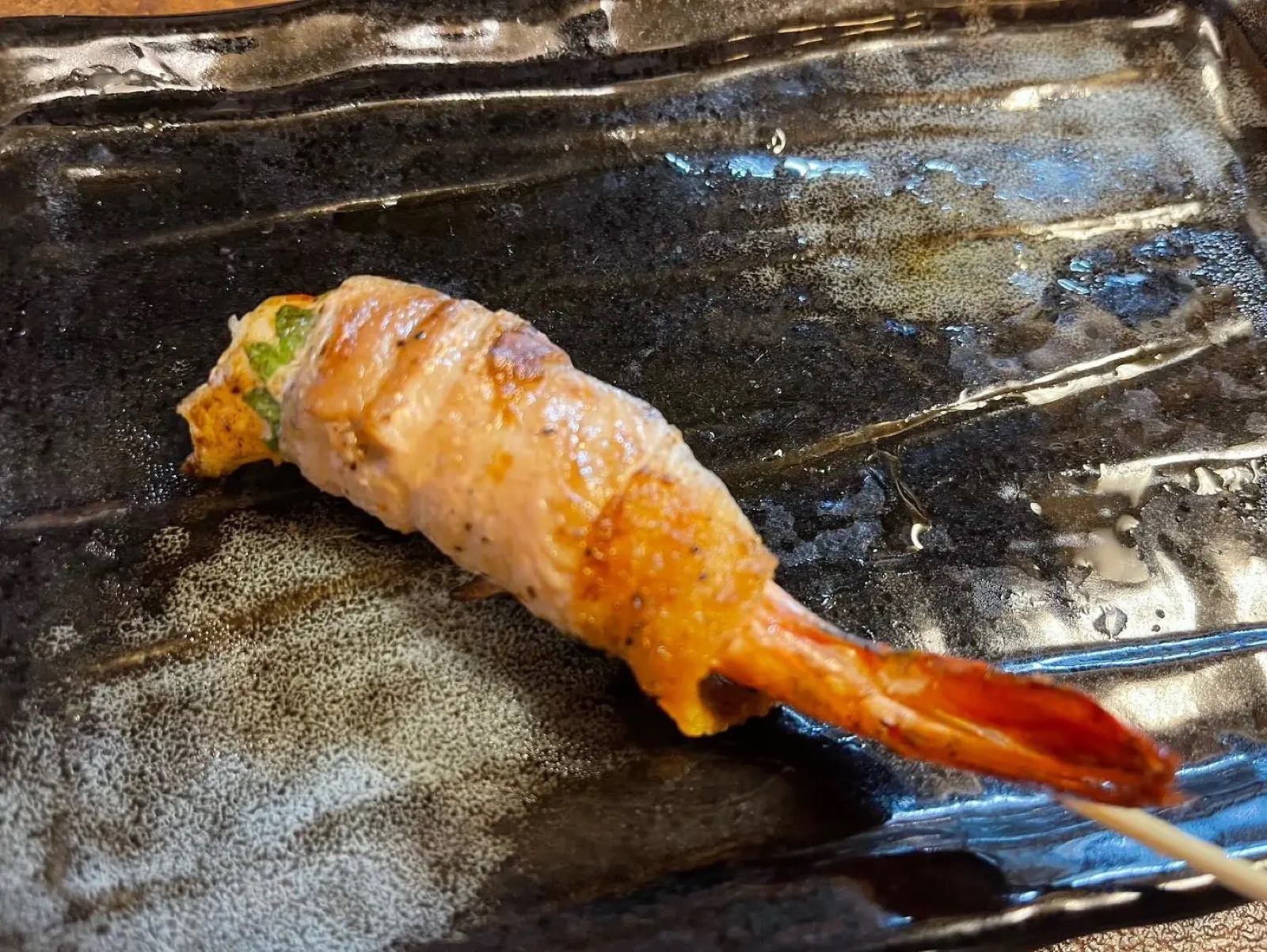
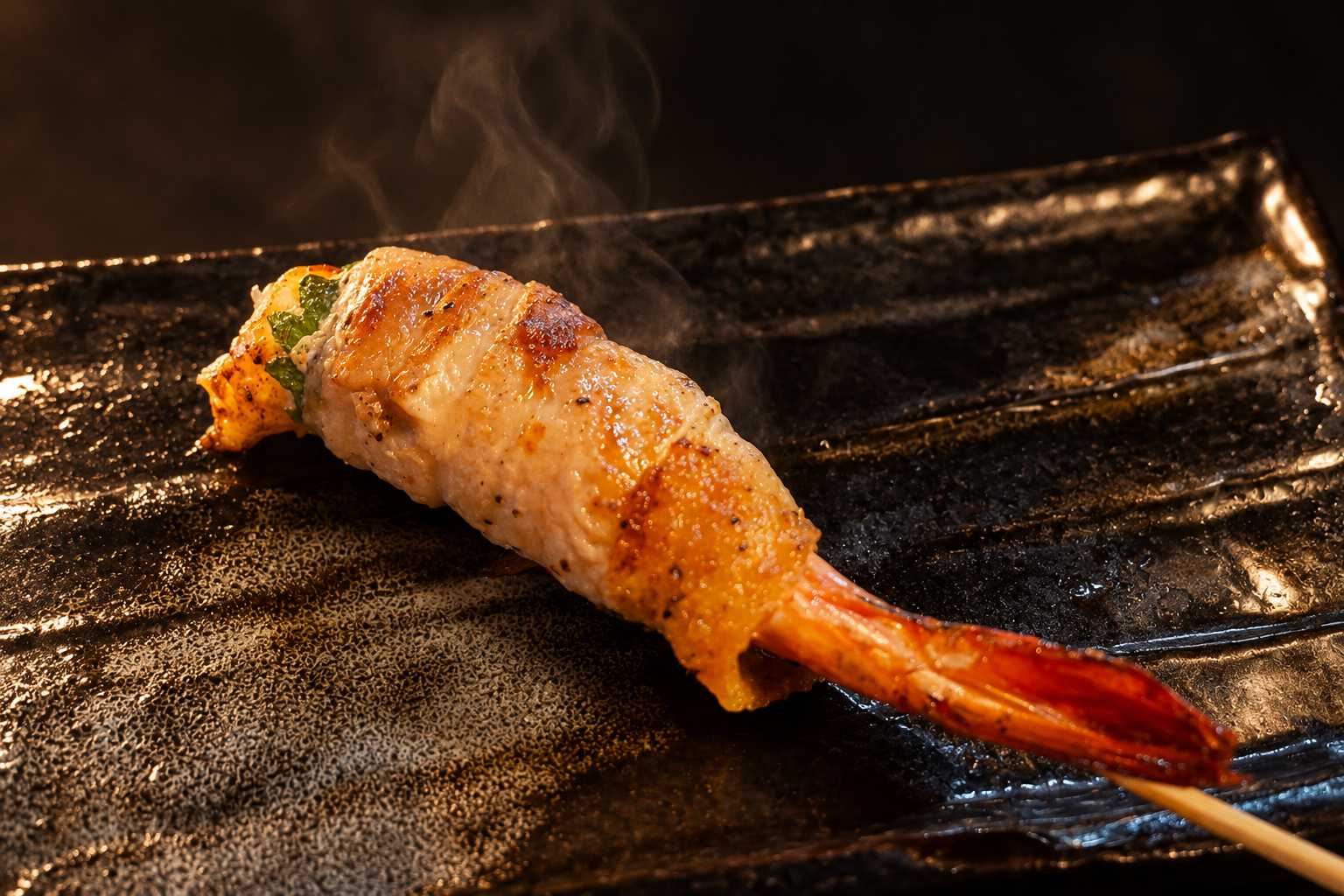
In the photo of the shrimp and shiso wrap, one tail-on shrimp is wrapped in pork belly and threaded on a skewer. A green leaf, the ooba, peeks out from the end of the roll, and the shrimp tail has turned red on the grill. Ooba is the leaf of green shiso, whose fresh aroma is paired here with the richness of the pork.
Pork is always cooked through
Some restaurants advertise chicken skewers that are rare or half-cooked, but pork is different. According to the Ministry of Health, Labour and Welfare, since 12 June 2015 the Food Sanitation Act has banned selling or serving pork meat or offal for raw consumption. Eating raw pork carries a risk of serious food poisoning from hepatitis E virus and food poisoning bacteria, and the ministry adds that freshness makes no difference.
For businesses, the ministry calls for heating to the centre, for example at least 30 minutes at 63°C or at least 1 minute at 75°C at the core. With pork belly wraps the filling cooks differently from the meat, and the rolled slices overlap, so they can take a little longer to grill. If you are concerned about the colour of the meat on a skewer you receive, please feel free to tell the staff.
Asparagus seasons and origins
According to the Agriculture & Livestock Industries Corporation (alic), asparagus is on sale all year, but its season is spring to early summer. Japanese asparagus is available roughly from April to October; from around October to the following March, when domestic shipments fall, it is imported from countries such as Mexico and Australia, where the seasons are reversed.
This means asparagus eaten in autumn or winter may be imported. We could not confirm from public information where Yakitori Senkichi's asparagus comes from. If origin matters to you, ask the restaurant about that day's supply.
What to check about skewers with shrimp
Shrimp is one of the specified allergens that must be labelled on packaged processed foods in Japan. However, as Sakai City's guide to allergy labelling explains, this labelling obligation does not apply to dishes served in restaurants. When eating out, it is important to tell the staff and ask yourself.
- If you are allergic to shrimp or other crustaceans, tell the staff before ordering
- If you are concerned whether skewers without shrimp are grilled on the same grill or with the same tools, ask
- If you do not like ooba (green shiso), ask whether it can be left out
- If you do not eat pork, remember that every dish called butabara-maki is wrapped in pork
- Prices and items can change, so check the menu on the day
Please make the final decision on allergies and whether to eat a dish based on your own health and what the restaurant tells you. This article is based on general information and published photos; it does not describe Yakitori Senkichi's cooking process in detail.
Japanese phrases for ordering
To ask in the restaurant, you can say "Asupara no butabara-maki o ippon kudasai" (one asparagus pork belly wrap, please), "Ebi ni arerugī ga arimasu" (I am allergic to shrimp) or "Ōba o nuku koto wa dekimasu ka?" (can you leave out the shiso?). For the basics of ordering yakitori, see how to order yakitori in Osaka; for skewers other than chicken, see reading a yakitori menu beyond chicken; and for crustacean allergies, see our article on kanikama-yaki.
For the location and opening hours of Yakitori Senkichi Minamikyuhoji, see the information at the bottom of this page or the official website.
Sources and further reading
- Ministry of Health, Labour and Welfare: Do not eat raw pork meat or offal (Japanese)(Checked: )
- Agriculture & Livestock Industries Corporation (alic): Vegetable of the month, asparagus (June 2025, Japanese)(Checked: )
- Sakai City: About food allergy labelling (Japanese)(Checked: )
- Yakitori Senkichi official website(Checked: )