/ Osaka Food / English
Wagyu Skewers at a Yakitori Restaurant: Wagyu vs Domestic Beef, What A5 Really Means, and What to Ask Before You Order
"Wagyu" on a yakitori menu is a word about cattle breed, not the same thing as "domestic beef". Using a photo Yakitori Senkichi published on Google, this guide explains the difference, what A5 does and does not tell you, what a menu name leaves out, the Japanese to use when asking, and how to think about doneness.
Written by Koetsu Co., Ltd.
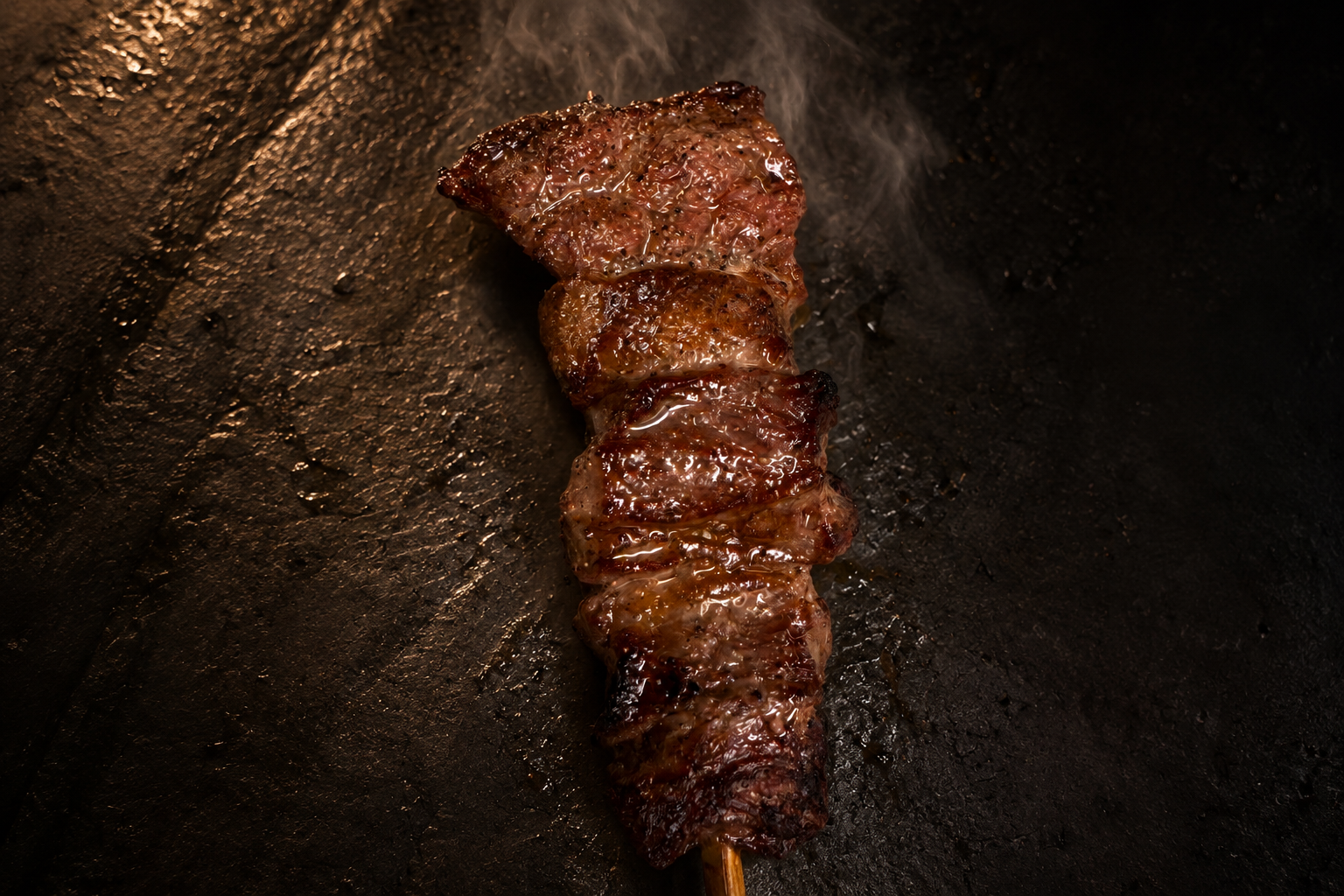
Yakitori restaurants do not always stop at chicken, and many menus include a beef skewer. At Yakitori Senkichi in Minamikyuhoji, the ordering menu listed a wagyu skewer (和牛串焼き, wagyu kushiyaki) as of October 2026. The word that raises questions is wagyu. Many visitors assume it simply means Japanese beef.
In fact, wagyu and domestic beef are defined by different criteria, and A5 is a separate matter again. This guide sorts out the three terms, what a menu name can and cannot tell you, and how to ask at the restaurant.
Wagyu is about breed; domestic beef is about where the animal was raised
According to the agriculture ministry's magazine, wagyu is a category based on breed. It covers only four breeds improved in Japan (Japanese Black, Japanese Brown, Japanese Polled and Japanese Shorthorn) and crosses among them. More than 90% of the wagyu fattened in Japan is said to be Japanese Black.
The explanation from ALIC, a government-affiliated agriculture agency, says domestic beef (国産牛, kokusangyu) means cattle raised longer in Japan than anywhere else, whatever the breed. The same page says beef labelled wagyu must come from the four breeds or their crosses, born and raised in Japan. Outside Japan you may see the word wagyu used differently, so this applies to labels in Japan.
| Term | What it looks at | What it tells you | What it does not tell you |
|---|---|---|---|
| Wagyu | Breed (four breeds and crosses) | The breed group | Region, cut or grade |
| Domestic beef | Time raised in Japan | Raised mainly in Japan | Breed, cut or grade |
| Grades such as A5 | Carcass yield and meat quality | Yield and a quality assessment | Breed, region, or whether you will like it |
A5 is neither another word for wagyu nor a promise of flavor
According to ALIC's explainer, the letters A to C are a yield grade showing how much meat a carcass gives, and the numbers 1 to 5 are a quality grade. The quality grade looks at marbling, meat color, firmness and texture, and fat color and quality, and it is set by the lowest of the four.
So A5 is an assessment of yield and quality. Because well-marbled meat tends to rank higher, a bigger number is not automatically better if you prefer lean beef. A menu that says wagyu also does not state a grade, and this article makes no claim about the grade used for our skewer.
Our wagyu skewer in the photo
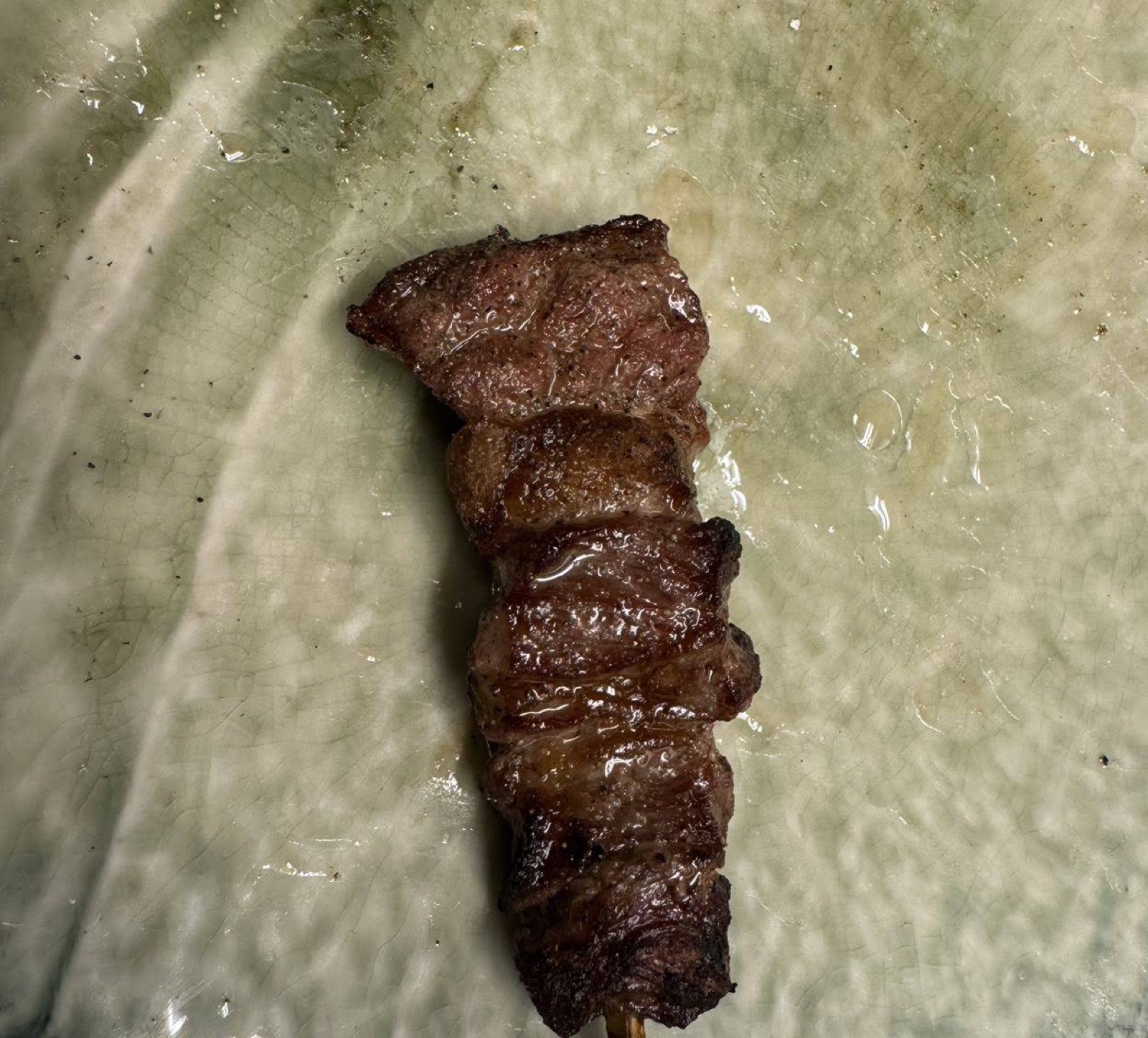
In the photo, the beef is packed tightly on the skewer with a firm sear on the surface. Next to chicken skewers the color is noticeably darker. It sits on a pale green glazed plate with no garnish. Plates and presentation may vary from day to day.
What you can ask before ordering
A menu name does not tell you the cut, region, grade or seasoning. If any of these matter to you, it is simplest to ask before ordering. During busy times staff may not be able to answer right away, so narrowing it down to one or two questions helps.
- Ask the cut: Wagyu kushiyaki wa, dono bui desu ka? (Which cut is the wagyu skewer?)
- Ask the seasoning: Ajitsuke wa shio desu ka, tare desu ka? (Is it salt or sauce?)
- Ask for doneness: Naka made shikkari yaite moraemasu ka? (Could you cook it through?)
- Ask availability: Kyo, wagyu kushiyaki wa arimasu ka? (Do you have the wagyu skewer today?)
On our menu, the wagyu skewer appeared in the Today's Recommendations section. Items in sections like this can change from day to day, so please check the menu on the day or call for the current price and availability.
Thinking about doneness
Some people say beef is better red in the middle, but the health ministry's Q&A explains that enterohemorrhagic E. coli is killed by heating at 75°C for at least one minute. It also advises against giving raw or undercooked meat to children, older people and others at higher risk.
If you are with children or older relatives, or are concerned about your own health, feel free to ask for it to be cooked through. This may take a little longer, so adding it to your first order makes the wait easier to plan around.
How to fit it in with chicken skewers
At a yakitori restaurant, one beef skewer can be enough to add some variety. You might start with chicken such as negima and add it partway through, which makes the difference easier to notice. This is only one suggestion, and any order is fine. For the basics, see our yakitori ordering guide, and for another non-chicken option, see the basashi dinner guide.
Menu and restaurant details for Yakitori Senkichi Minamikyuhoji are on the official website. This article reflects what we checked on November 3, 2026, and does not state a specific cut, region or grade.
Sources and further reading
- MAFF magazine aff, August 2016: feature on wagyu (Japanese)(Checked: )
- ALIC: Are wagyu and domestic beef different? (Japanese)(Checked: )
- ALIC: Do you know how meat is graded? (Japanese)(Checked: )
- Ministry of Health, Labour and Welfare: enterohemorrhagic E. coli Q&A (Japanese)(Checked: )
- Yakitori Senkichi official website(Checked: )